
Unit 10 Government as economic actor: Economics, politics, and public policy
10.8 Scope for political rent-seeking under different political systems
Why do political elites in autocratic systems oppose democracy? And why might they sometimes concede to a more democratic system?
In this section, we extend our model of a government maximizing political rents beyond the case of a dictator with absolute power, to other self-interested regimes. We continue to assume that the government is interested only in maximizing total rent. But if its power is limited by the political environment, the constraints that it faces will differ.
Figure 10.14 lists examples of the duration in office of governing elites in a variety of political environments. Elections play a part in the political systems in all of these countries, but in some cases do little to constrain the elite. The longest rule by an individual at the head of a governing elite was by Fidel Castro (49 years) in Cuba, who was then succeeded by his brother Raúl. Although elections are held, Cuba remains a one-party state. There are examples of elected governments removed from power by non-electoral means, and of revolutionary governments—like the Sandinistas in Nicaragua—that are followed by transition to free and fair elections. In India and Mexico, elected political parties maintained a grip on power for decades.
| Governing elite | Country | Rule | Came to power by | Left power by |
|---|---|---|---|---|
| Congress Party | India | 1947–1977 | Election (end of colonial rule) | Election |
| Communist Party | Cuba | 1959– | Revolution | Still in power as of 2025 |
| Social Democratic Party | Sweden | 1932– 1976 | Election | Election |
| Second Republic | Spain | 1931– 1939 | Election | Military coup civil war |
| Francisco Franco | Spain | 1939– 1975 | Military coup, civil war | Natural death; return to democracy |
| Institutional Revolutionary Party | Mexico | 1929– 2000 | Election | Election |
| Democratic Party | US | 1933– 1953 | Election | Election |
| Sandinista Party | Nicaragua | 1979– 1990 | Revolution | Election |
| African National Congress | South Africa | 1994– | Non-violent revolution and election | Still in power as of 2025 |
| Australian Labor Party | Australia | 1972– 1975 | Election | Dismissed by (unelected) executive |
Figure 10.14 Examples of governing elites, and how they achieved and lost power.
In this section, we will think of the government not as a dictatorship that can be removed from power only by revolution, but as a governing elite consisting of top officials and legislative leaders, unified by a common interest such as membership of a particular political party. Now, the government faces opposition within an electoral system, and the governing elite can be removed from office by losing an election.
The duration curve for a government facing elections
We can derive a duration curve in the same way as in the previous section. As before, the government may be removed from office for performance-related reasons—in the model, if it sets too high a level of tax. Or it may be removed for reasons beyond its control—even governing elites that serve the interests of their citizens often lose elections. Again, we will assume that the probability of removal for non-tax reasons is 10%. Hence there is a trade-off between the tax level and the expected duration of the government like the one in Figure 10.12: a downward-sloping duration curve. It reaches zero rent at an expected duration of 10 years (which is how long the government would expect to stay in office if every year there was a 10% chance of their being removed).
So what difference do fair elections make to our model? The answer is that the political and electoral system affects how much the government’s expected duration is reduced if it raises taxes above the cost of public services. For example, if citizens can remove the government by voting in free and fair elections, we can expect duration to be more sensitive to government performance than in the case of a dictatorship that could only be removed by difficult or dangerous means—such as an uprising.
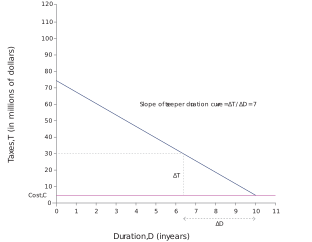
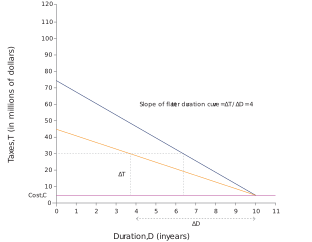
Figure 10.15 shows that the sensitivity of duration to tax rises corresponds to the slope of the duration curve. Suppose that the government increases taxes above the cost of public services by an amount \(\Delta T\) = $25 million. First consider a relatively steep duration curve: the tax rise reduces duration from 10 to 6.4 years, so the change is \(\Delta D\) = 3.57 years. Work through the steps to understand why a flatter curve has greater sensitivity to the tax level, representing a more democratic system. Raising taxes for the purposes of rent-seeking leads to a higher probability of losing elections, and a larger fall of 6.25 years in the expected duration of governance.
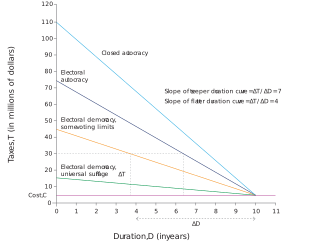
Figure 10.15 Duration curves, democracy, and the sensitivity to tax rises.
A steep duration curve
A flatter duration curve
Duration curves and political systems
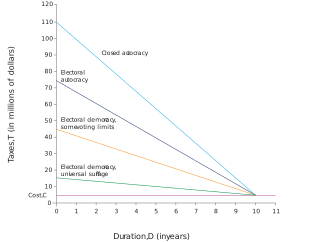
We can think of the differing slopes of the duration curves in the last step of Figure 10.15 as capturing the degrees of political competition in different political systems. The curve is flatter where the political system is more competitive. Just as competition disciplines the owners of firms in the economy by limiting the profits they can get by setting too high a price, competition to win elections is the way that a democracy disciplines its politicians to provide the services desired by the public at a reasonable cost (in terms of taxes).
How political competition affects taxation and rent
The key idea in our model is that political competition makes the likelihood of losing an election more dependent on the government’s performance. This means that it makes the duration curve flatter. In other words, an increase in taxes by the government will have a larger effect on the elite’s expected duration in office than it would if there was no political competition.
Then, when the governing elite chooses a tax level to maximize its total political rent, the slope of the duration curve affects how much rent it is able to extract. Figure 10.16 compares the outcome in two situations: where the government faces greater or lesser political competition.
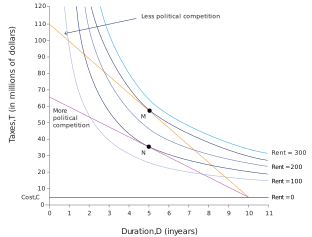
Figure 10.16 Choice of taxes under less and more competitive conditions.
In a less-competitive system, the governing elite chooses point M, with high tax revenue of $57.5 million per year, and expected duration of 5 years. With more political competition the feasible set is smaller. The government’s chosen outcome is N, where both annual tax revenue and total rent are lower.
Note that in Figure 10.16, the governing elite in a more competitive political system implements lower taxes but has the same expected duration as the elite in the less-competitive system. This feature of the model arises from the modelling assumptions we have made about the duration curves (they are straight lines meeting the horizontal cost line at the same duration level) and also the government’s objective (to maximize rent). With a more general shape for the duration curve and government indifference curves, more competitive conditions could lead to either longer or shorter expected duration.
Building block
These two effects are the substitution effect and the income effect that feature in many constrained choice problems. These are explained in Section 3.7 of the microeconomics volume. The example in Figure 10.16 is very similar to the case illustrated there: the effect of a change in the wage on an individual’s choice of working hours.
This happens because there are two opposing effects of an increase in political competition:
- Raising taxes brings a heavier risk of the governing elite being dismissed. The duration curve is flatter, so the opportunity cost of an additional year of duration (in terms of lost tax revenue) is lower. This effect on its own would cause the governing elite to choose a higher duration.
- The governing elite has lost some of its power. The duration curve has moved inward, reducing the feasible set: it has less power to obtain rent because its expected duration is shorter at every tax level. This effect on its own would cause the elite to choose lower duration.
With the particular assumptions in our model, these effects exactly offset each other. More competition reduces the tax rate with no change in expected duration.
Why a dictator might resist democracy
The model helps show why governing elites, and the wealthy and powerful members of society who are allied to these elites, have so often resisted democracy and attempted to limit the political rights of the less well-off. When voting is restricted to the wealthy, the elite faces little political competition, and obtains high total rents (point M in Figure 10.16). But now suppose that everyone has the right to vote and opposition political parties are allowed to challenge the elite. The increase in political competition flattens the duration curve and reduces the feasible set. The best the elite can do is choose point N. Democracy has reduced its scope for collecting political rent.
An ‘ideal’ democracy in the model
In our model, greater democracy corresponds to an increase in political competition, flattening the duration curve and constraining the ability of a self-interested elite to extract political rent. A democratic system that was very effective in preventing rent extraction would be represented by a duration curve that was almost flat. We could think of the limiting case of a completely flat duration curve as representing an ‘ideal’ democracy. In such a system, being in government would hold no attractions for purely self-interested politicians. The electoral system would ensure that political parties with other motives—ideology or benevolence, for example—entered the competition for office, and that parties reflecting the preferences of voters would succeed.
Exercise 10.8 Income and substitution effects
- income effect
- The effect that an increase in income has on an individual’s demand for a good (the amount that the person chooses to buy) because it expands the feasible set of purchases. When the price of a good changes, this has an income effect because it expands or shrinks the feasible set, and it also has a substitution effect. See also: substitution effect.
- substitution effect
- When the price of a good changes, the substitution effect is the change in the consumption of the good that occurs because of the change in the good’s relative price. The price change also has an income effect, because it expands or shrinks the feasible set. See also: income effect.
Note: To do this exercise, you will need to be familiar with income effects and substitution effects. To review these concepts, read Section 3.7 of The Economy 2.0: Microeconomics.
Using the concepts of income and substitution effects and how they can be analysed in a diagram with indifference curves and feasible frontiers, redraw Figure 10.16 to show the decomposition of the final choice after increased competition into the income effect (reduction in duration, D) and the substitution effect (increase in D).
Extension 10.8 The income and substitution effects of an increase in political competition
In Extension 10.7, we solved the rent-seeking government’s constrained choice problem mathematically for the case of a linear duration curve, to find the tax level it chooses and the corresponding expected duration in office. We now use those results to show that an increase in political competition lowers the tax level but does not change the government’s duration. Using the same methods as in Extension 3.7 of the microeconomics volume, we explain how this arises from an income effect that reduces duration, and an offsetting substitution effect that increases it.
The constrained choice problem for a rent-seeking government with a linear duration curve is to choose the annual tax, \(T\), and expected duration, \(D\), to:
\[\text{maximize }(T-C)D \text{ subject to }T= C + s(D^\text{max}-D)\]The parameter \(s\) is the absolute value of the slope of the duration curve, and \(D^\text{max}\) is the maximum possible duration—the expected duration corresponding to a tax, \(T\), equal to the cost of public services, at which rent is equal to zero. In the dictator model, the maximum expected duration is determined by the probability, \({\delta^0}\), of losing office for non-performance reasons: \(D^\text{max}=\frac{1}{\delta^0}\).
We solved this problem in Extension 10.7 to obtain:
\[\begin{align*} D^* &= \frac{1}{2} D^\text{max} \\ T^* &= C+\frac{s}{2} D^\text{max} \end{align*}\]The amount of rent that the government receives is:
\[R^*=(T^*-C)D^*= \frac{1}{4}s \left( D^\text{max} \right)^2\]The main part of this section showed that compared to a dictatorship (no political competition), a self-interested rent-seeking government that faces political competition chooses \(T\) and \(D\) in a similar way, but the duration curve is flatter. The slope parameter, \(s\), captures the extent of political competition. More competition corresponds to a lower value of \(s\).
By examining the solution of the rent-maximization problem, we can therefore determine exactly how political competition affects the outcome for the governmental elite.
Suppose that there is an increase in political competition: \(s\) falls, while \(D^\text{max}\) remains constant. In the dictator model (Extension 10.7), this corresponds to an increase in the probability of dismissal for performance-related reasons, with no change in probability of dismissal for other reasons.
- Considering the expression for \(T^*\), we can immediately deduce that the rent-seeking elite will choose a lower annual tax: \(T^*\) falls.
- However, the expected duration will not change; \(D^*\) does not depend on \(s\).
- Since tax falls and duration remains the same, the government obtains less total rent as a result of the rise in competition.
This is the situation illustrated in Figure 10.16, reproduced below as Figure E10.2. It moves the outcome from M to N, on a lower isorent curve. In effect, competition shrinks the feasible set, thereby reducing the power of the elite to extract rent.
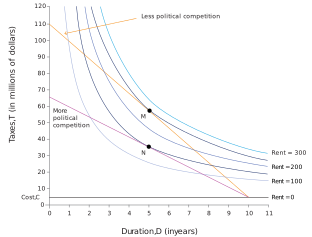
Figure E10.2 Choice of taxes under less and more competitive conditions.
The result that the expected duration does not change in response to an increase in competition arises from the combination of two opposing effects on duration, which we can think of as an income effect and a substitution effect. In a rent-maximization problem with a linear constraint, these two effects exactly offset each other. In the case of a more general duration curve, the combination of the two effects could raise or lower duration.
The income and substitution effects of an increase in political competition
Building block
You may find it helpful to read Section 3.7. of the microeconomics volume, including the extension, before proceeding.
We can decompose the effect of a fall in \(s\) on duration in the same way as in Section 3.7 of the microeconomics volume for the effect of a wage change on free time.
To understand why these two problems are similar, remember that in the microeconomic model for the choice of consumption and free time, the feasible frontier is the budget constraint. A change in the wage changes the slope of the frontier, and a change in unearned income leads to a parallel outward or inward shift of the frontier.
Likewise in the rent-seeking government model, the feasible frontier is the duration curve. A change in political competition changes its slope, \(s\), and a change in \(D^\text{max}\) leads to a parallel shift.
Suppose political competition increases, reducing the slope of the feasible frontier from \(s_0\) to \(s_1\). We can think of this as affecting the government’s choice in two ways, as illustrated in Figure E10.3.
- The income effect. First, the probability of dismissal is higher whatever the tax level, so the feasible set shrinks. The income effect shows what would have happened if the probability had increased for non-performance reasons. There will be a parallel inward shift of the duration curve, moving the outcome from M to L: duration falls.
- The substitution effect. But, in addition, raising taxes now has a bigger impact on expected duration—the opportunity cost is higher. This leads the government to reduce taxes more than it would do if the dismissal probability had risen for non-performance reasons. The change in the slope of the duration curve moves the outcome from L to N: duration increases.
With a linear duration curve the fall in duration due to the income effect is the same size as the increase due to the substitution effect, so the overall effect is zero. The duration at N is the same as at M, as shown in Figure E10.3.
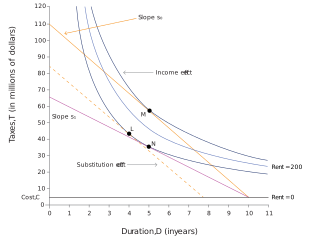
Figure E10.3 Income and substitution effects of an increase in political competition that reduces the slope of the feasible frontier from \(s_0\) to \(s_1\).
We can calculate the income and substitution effects algebraically using the same four steps described in Extension 3.7 in the microeconomics volume. As in the graphical analysis in Figure E10.3, suppose that the rise in competition reduces \(s\) from \(s_0\) to \(s_1\), while \(D^\text{max}\) remains constant.
Using the expressions derived for \(D^*\) and \(R^*\) at the outcome of the rent-maximization problem, we can say that initially, when \(s=s_0\), the government’s expected duration is:
\[D_0= \frac{1}{2} D^\text{max}\]and it obtains rent:
\[R_0 = \frac{1}{4}s_0 \left( D^\text{max} \right)^2\]Step 1: What is the total rent and duration after \(s\) falls?
Rent is lower than before:
\[R_1 = \frac{1}{4}s_1 \left( D^\text{max} \right)^2\]But expected duration does not change:
\[D_1= \frac{1}{2} D^\text{max}\]Step 2: What change in \(D^\text{max}\) would have the same effect on total rent?
Suppose that instead of rotating inwards, the duration curve had made a parallel shift inwards, reducing the maximum duration to \(\overline{D}\), giving a duration curve:
\[T= C + s_0(\overline{D} - D)\]In this case, the government would obtain rent of \(\frac{1}{4}s_0\overline{D}^2\). The effect on rent would be the same if:
\[\begin{align*} \frac{1}{4}s_0 \overline{D}^2 &= \frac{1}{4}s_1 \left( D^\text{max} \right)^2 \\ \Rightarrow \overline{D} &= \sqrt{\frac{s_1}{s_0}}D^\text{max} \end{align*}\]Step 3: Find the income effect
How would the change in Step 2 affect duration?
The government would choose \(D_2= \frac{1}{2} \overline{D}\). So the income effect leads to a fall in duration of:
\[D_0-D_2=\frac{1}{2}\left(1-\sqrt{\frac{s_1}{s_0}}\right) D^\text{max}\]Step 4: Find the substitution effect
We know that the overall effect on duration is zero: \(D_1 =D_0= \frac{1}{2}D^\text{max}\). So the substitution effect must raise duration again, from \(D_2\) to \(D_0\).
Exercise E10.2 Political competition and taxation
Consider again the effect of a rise in political competition that reduces the slope of the duration curve from \(s_0\) to \(s_1\), while \(D^\text{max}\) remains constant. Derive expressions for the changes in tax corresponding to the income and substitution effects on duration. Explain intuitively why both effects result in a reduction in taxes.
